
If you’ve ever been asked about getting a scan, chances are you’ve heard this question:
“Should I go for a CT scan or an MRI ?”
And honestly… it can feel very confusing.
Both sound technical. Both are used in hospitals. And both help to doctors see inside your body.
But when it comes to CT scan vs. MRI, they’re actually very different.
Let’s break it down in a way that is actually beneficial for everyone, no anytype of complicated medical jargon, just talk about what is real.
- CT Scan vs. MRI: Let's learn about the Basic Idea
- What is a CT Scan?
- What is an MRI?
- CT Scan vs. MRI: What are the Key Differences
- What Does It Feel Like?
- CT Scan vs. MRI: Which One is Better?
- Cost Difference (as per your country's perspective)
- Are There Any Risks?
- When Do Doctors Recommend a CT Scan vs. an MRI?
- Final Thoughts: CT Scan vs. MRI Made Simple
- One Last Thing, keep in mind
CT Scan vs. MRI: Let’s learn about the Basic Idea
First of all, think of both scans like cameras.
Just not the kind you use on your phone, but super advanced ones that can look inside whatever’s going on in your body.
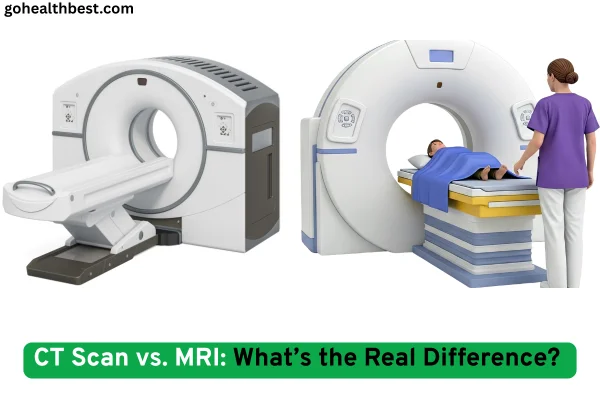
- A CT scan uses X-rays.
- An MRI uses magnets and radio waves.
That is the core difference.
But what does that really mean for you?
Let’s go in deeper.
You can also learn more about Lipid Profile Test: Complete Guide to Cholesterol, Normal Range & Results

What is a CT Scan?
A CT scan, or Computed Tomography, is basically a faster and more detailed version of an X-ray.
Instead of taking just one image, it takes multiple images from different types of angles and finally combines them.
First, you imagine that,
You cut a cake into slices and look at each slice separately.
That’s the same process as how a CT scan shows your body layer by layer.
A CT Scan is commonly used for:
- Broken bones
- Internal injuries (especially after accidents)
- Lung infections or issues
- Detecting bleeding inside the body
Why doctors choose CT scans:
- Very fast (sometimes done within 5 minutes)
- Great for any kind of emergencies
- Widely available in most of the hospitals
What is an MRI?
An MRI (Magnetic Resonance Imaging) is completely different from other imaging methods.
It doesn’t use any kind of radiation at all.
But it uses strong magnets as well as radio waves to create high-quality images.
Think of it like:
A high-definition, zoomed-in view of your body’s soft tissues.
MRI is good for:
- Brain and nerve issues
- Any kind of spinal cord problems
- Any type of Muscle injuries
- Ligament tears
- Any type of tumors
Why do doctors mostly prefer MRI:
- To get perfectly detailed images
- Best for soft tissues
- No kind of radiation exposure
CT Scan vs. MRI: What are the Key Differences
Let’s learn CT Scan vs. MRI and take it simple:
| CT Scan | MRI | |
| Technology | Uses as X-rays | Uses as magnets |
| Speed | Very fast | Takes a long time (25–55 minutes) |
| Best For | Bones, bleeding, emergencies | Best for Soft tissues, brain, and muscles |
| Radiation | Yes | No any kind of radiation |
| Comfort | Quick and easy process | You can feel tight and noisy |
What Does It Feel Like?
This is something people don’t always talk about, but it matters every time.
CT Scan Experience:
- You lie on a table
- The machine moves around you
- It’s a quick and painless process
Most people are done before they even feel anything.
MRI Experience:
- You lie inside a tunnel-like machine
- It takes a long time
- The machine makes loud knocking sounds when the process runs.
If you’re someone who doesn’t like any kind of closed spaces, it can feel a bit uncomfortable.
But don’t worry about it, you’ll usually get earplugs and guidance during the process.
You can also learn more about Symptoms of Kidney Disease: Early Warning Signs You Need to Know.
CT Scan vs. MRI: Which One is Better?
As per my experiance i want to give the honest answer here,
There is no “better” scan.
It depends on what your doctor is trying to find out about it.
Let’s understand with some examples:
- Head injury after an accident → CT scan
- Knee ligament tear → MRI
- Suspected brain issue → MRI
- Chest injury → CT scan
So instead of thinking “Which is better?”, think about:
“Which is right as per my situation?”

Cost Difference (as per your country’s perspective)
Let’s talk about something practical, cost.
In India:
- CT Scan cost: ₹2,000 – ₹8,000
- MRI cost: ₹5,000 – ₹20,000
MRI is usually more expensive because of the advanced technology involved.
Are There Any Risks?
CT Scan Risks:
- Uses radiation (generally it is safe, but repeated exposure should be avoided)
MRI Risks:
- Not suitable if you have metal implants, pacemakers, or any other devices
- The strong magnet can interfere with metal objects
First of all, inform your doctor about your past medical history before the scan.
When Do Doctors Recommend a CT Scan vs. an MRI?
Doctors do not choose CT scan vs. MRI randomly.
They mostly look at:
- What are your symptoms
- Your past medical history
- The urgency of the situation
Quick guideline:
- If an emergency? → CT scan
- Find a detailed soft tissue check? → MRI
If you face a problem regarding vitamin B12, then you can try Vitamin B12: Benefits, Sources, and Ayurvedic Remedy
Final Thoughts: CT Scan vs. MRI Made Simple
If all this still feels overwhelming, just remember this thing:
- CT scan = Fast + best for bones and any kind of emergencies
- MRI = Detailed + best for soft tissues
That’s it.
CT scan vs. MRI is make very easy to understand for everyone.
Quick Summary about CT scan vs. MRI (Save this for remembering)
- A CT scan uses X-rays
- MRI uses magnets
- A CT scan is a faster process
- MRI is more detailed
- CT is used in emergencies
- MRI is used for rich in-depth analysis
One Last Thing, keep in mind
If your doctor recommends a scan, don’t panic about it.
It doesn’t mean something is seriously wrong.
It just means they want a clearer picture. and so they can treat you better.
And that’s a good thing.
At last but not a list If you found this article helpful, share it with someone who might be confused about CT scan vs. MRI. It could really help them understand things very well.