
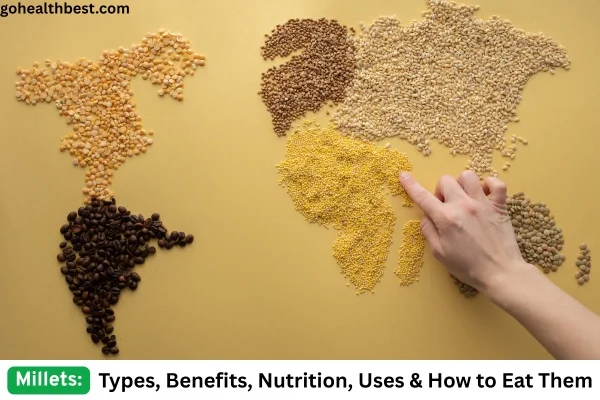
If you’ve been trying to eat healthier lately, you’ve probably heard the word millets quite a lot.
They’re in everything these days—from dosa and roti to khichdi, porridge, cookies, and even ready-to-eat snacks.
But here’s the honest question: Are millets really that healthy, or are they simply another food trend?
The good news is that millets are not a new trend at all. They have been an important part of our traditional diets in India and other parts of the world for thousands of years.
They are a nutritious, versatile, naturally gluten-free option, and fairly easy to add to your everyday meals.
Let’s take a very close look at millets, their types, benefits, nutrition, uses, and the best ways to eat them.

What Are Millets?
Millets are a kind of group of small-seeded grains that belong to the grass family.
They have been grown for generations because they can tolerate relatively dry conditions and don’t always need too much water as some other cereal crops require.
In India, it have traditionally been used to make types of foods such as roti, dosa, porridge, khichdi, and some fermented dishes.
Today, they are becoming very popular again as people like to improve nutritious alternatives to refined grains.
One important thing that you remember is that they are not any kind of magic food. They’re simply nutritious whole grains that can be part of your balanced diet.
- What Are Millets?
- Different Types of Millets
- What Are the Health Benefits of Millets?
- Millets Provide Important Nutrients
- Millets Are Naturally Gluten-Free
- Millets Can Help Add Variety to Your Diet
- Are Millets Good for Weight Loss?
- Are Millets Good for Diabetes?
- How to Eat Millets
- How to Cook Millets
- Can You Eat Millets Every Day?
- Are There Any Disadvantages of Millets?
- Millets vs Rice: Which Is the Better Option?
- A Simple Millet Meal Plan
- My Final Thoughts
- Frequently Asked Questions on Millets
Different Types of Millets
There is not just one type of millet. There are types of varieties, and each has its own taste, texture, as well as nutritional profile.
1. Pearl Millet (Bajra)
Pearl millet is one of the most commonly eaten millets in India. This is very popular, and everyone likes to eat it.
It has a slightly nutty, earthy flavor and is traditionally used to make bajra roti.
It can also be used in porridge, khichdi, and other types of dishes.
Bajra provides fiber, protein, minerals, and several types of B vitamins.
2. Finger Millet (Ragi)
Ragi, also called finger millet, is especially very popular in South India.
It is widely known for its calcium content and is commonly used to make:
⦁ Ragi dosa
⦁ Ragi roti
⦁ Ragi porridge
⦁ Ragi mudde
⦁ Ragi pancakes
Its slightly earthy flavor may take some getting used to, but once you find a recipe you like, it’s quite easy to include.
3. Sorghum (Jowar)
Here, jowar is another traditional Indian grain. It plays an important role in weight loss.
Jowar flour is most commonly used to make rotis.
It can also be cooked like a grain and added to salads, bowls, and other types of dishes.
It is a naturally gluten-free option and provides fiber, protein, and types of minerals.
4. Foxtail Millet
It has a mild, slightly nutty taste.
It’s particularly easy to use as an alternative to rice.
You can make forms from foxtail millet:
⦁ Types of pulao
⦁ Millet upma
⦁ Millet khichdi
⦁ Millet bowls
5. Little Millet
It is another versatile variety.
It can be cooked and served with dal and vegetables or used in dishes like upma, pulao, as well as khichdi.
6. Kodo Millet
Kodo millet has a slightly chewy texture when cooked.
It is part of used in our traditional dishes and can be a best alternative to rice when you want to add more variety to your meals.
7. Barnyard Millet
Barnyard millet is especially familiar in India because it’s often eaten during fasting.
It cooks relatively quickly and works very well in khichdi, pulao, and porridge.
8. Proso Millet
It is less familiar to many people but is still a very important type of millet variety.
It can be cooked like a grain and used to incorporate into different recipes.
You can also learn more about Types of Rotis for a Healthy Diet: A Complete Guide.
What Are the Health Benefits of Millets?
So, why are people adding millets to their diets?
There are several good reasons here.
Millets Can Be a Good Source of Fiber
Many whole millets provide us with dietary fiber.
Fiber helps support normal digestion and can also make a meal more filling.
If your current diet contains lots of refined grains and processed foods, replacing some of them with whole grains such as millets can be a sensible change.
Millets Provide Important Nutrients
Depending on the variety, millets can provide nutrients such as:
⦁ Magnesium
⦁ Phosphorus
⦁ Iron
⦁ Zinc
⦁ B vitamins
⦁ Fiber
⦁ Plant protein
The exact nutrition varies between millet varieties, so it’s better to eat a variety rather than focusing on one particular millet.
Millets Are Naturally Gluten-Free
I see most true millets are naturally gluten-free.
This makes them very effective for people who need to avoid gluten.
However, if you have celiac disease, be careful about cross-contamination during the time of processing as well as cooking. Certified gluten-free products may be a better choice.
If you want to try more Gluten-free recipes, then you can try Almond Flour Recipes: 12 Easy, Healthy & Delicious Ideas for Everyday Cooking.
Millets Can Help Add Variety to Your Diet
This benefit doesn’t get enough attention.
Eating healthy doesn’t have to mean eating the same foods every day.
If you usually eat rice for lunch, try millet occasionally.
If you normally eat wheat roti, try bajra or jowar roti.
Sometimes simply having more choices makes healthy eating easier.
Are Millets Good for Weight Loss?
This is one of the most common questions about it.
Here, my short answer is: they can fit into a weight-loss diet, but millets don’t automatically cause weight loss.
Most of the time, I really see weight management depends on your overall diet plan, your calorie intake, types of physical activity, your sleep time, and other lifestyle factors.
Here, it can be very useful because its fiber content may help make meals satisfying.
But portion size still matters more.
For example, a bowl of millet with vegetables and dal can be a balanced meal. A sugary millet dessert loaded with calories is a different story.
So don’t think of millet as a “fat-burning food.”
Think of it as one nutritious whole-grain option.
If you are really interested in Weight Management, then you can try Soya Milk: Benefits, Nutrition, Uses, Side Effects & Complete Guide.
Are Millets Good for Diabetes?
It may be a suitable option for some people with diabetes, but it’s not accurate to say that every millet automatically controls blood sugar.
Different millet varieties, processing methods, cooking methods, and portion sizes can affect blood glucose differently.
A whole or less-processed millet preparation may behave differently from finely milled millet flour.
If you have diabetes, pay attention to portions and what you eat alongside the millet.
And don’t replace prescribed diabetes treatment with dietary changes alone.
How to Eat Millets
You don’t need to completely change your diet.
Start small.
Here are some easy types of ideas:
In breakfast: You can eat ragi dosa with chutney and vegetables.
In lunch: Millet with dal, vegetables, and curd.
In dinner: Bajra or jowar roti with any sabzi.
In snack: You can try a homemade millet-based snack with minimal added sugar.
Comfort food: Millet khichdi with moong dal and vegetables.
You can also use millet flour to make dosa, pancakes, rotis, and other homemade foods, whatever you like.
How to Cook Millets
Here, cooking methods vary by millet type.
As a simple starting point, rinse the millet thoroughly before cooking.
Here, some varieties benefit from soaking, especially when you are using them in some special recipes.
Then you can cook them with water until they become tender.
The exact water ratio and cooking time depend on the type of variety, so it is best to follow the instructions for the specific millet you’re using.
If you’re new to millets, don’t worry about getting everything perfect on your first attempt.
Your first batch might be a little too soft—or a little too dry.
That’s completely normal.
Can You Eat Millets Every Day?
For most people, millets can be included regularly as part of a balanced diet.
But you don’t have to eat them at every meal.
It’s better to have variety.
You can rotate between rice, wheat, oats, jowar, bajra, ragi, and other whole grains.
Your overall eating pattern matters much more than whether you eat one particular grain every day.

Are There Any Disadvantages of Millets?
Millets are a nutritious option, but they are not perfect for everyone.
Because they are relatively high in fiber, if you eating a large amount suddenly may cause bloating or digestive discomfort in some people.
Here, I want to give you the best advice: if you’re not used to high-fiber foods, you can start with a smaller portion and increase gradually.
Also, I really see that some people may simply dislike the taste or texture.
That is okay.
Healthy eating shouldn’t feel like any punishment.
You can try different varieties and recipes until you find something you genuinely enjoy.
Millets vs Rice: Which Is the Better Option?
There’s no simple winner.
Both can be part of a healthy diet.
Millets can give more fiber and certain minerals depending on the variety, while rice is very familiar, versatile, and easy to digest for many people.
Instead of asking, “Should I completely stop eating rice?” a better question is:
“Can I include more whole grains and variety in my diet?”
For many people, the answer is yes.
A Simple Millet Meal Plan
If you’re wondering how to start, keep it easy.
Monday: Ragi dosa for breakfast.
Tuesday: Jowar roti with vegetables.
Wednesday: You can go with Regular rice.
Thursday: Try millet khichdi with dal and vegetables.
Friday: Bajra roti with any sabzi.
Saturday: Try Foxtail millet pulao.
Sunday: You can choose your favorite grain.
There is no need to force yourself to eat millet every single day.
My Final Thoughts
Millets are not a miracle food, and you don’t need to suddenly replace everything in your kitchen with the help of millet.
But they are nutritious traditional grains that deserve a place in a balanced diet.
Try ragi dosa one morning.
Have bajra roti with your favorite sabzi.
Make millet khichdi on a day when you want something comforting.
The goal isn’t perfection.
It’s simply to eat a little more variety and choose nourishing foods more often.
And that’s where millets can fit in beautifully.
Frequently Asked Questions on Millets
- What are millets?
Millets are small types of seeded cereal grains that we have grown and eaten for thousands of years. They have some Common types of varieties, including bajra, ragi, jowar, foxtail millet, little millet, kodo millet, barnyard millet, and proso millet.
- Which millet is best for our health?
No one millet’s best for everyone. Ragi, bajra, jowar, foxtail millet, and other varieties each have different types of nutritional qualities. Eating a variety is a better kind of approach for living healthy.
- Which millet is best for weight loss?
No millet directly causes weight loss. However, millet can be part of a weight-management diet because whole-grain varieties can provide fiber and make meals satisfying.
- Are millets gluten-free?
Most true millets are naturally gluten-free. People with celiac disease should still check labels and consider certified gluten-free products because of possible cross-contamination.
- Can I eat millets every day?
Yes, you can include millets regularly. However, the variety is very important, so there is no need to replace every grain in your diet with millet.
- Is ragi the same as millet?
Yes. Ragi is the Indian name commonly used for finger millet. It is one of several different millet varieties.
- Is bajra a millet?
Yes. Bajra is the common Indian name for pearl millet.
- Is jowar a millet?
Jowar is sorghum. It is commonly grouped with millets in everyday Indian nutrition discussions, although botanically it is classified separately from the small millets.
- Can children eat millets?
Here, you can add millets to children’s diets as part of age-appropriate and balanced meals. The texture and preparation should be very suitable for the child’s age.
- Are millets a better option than rice?
Not necessarily. Both can be part of a healthy diet. Here, millets offer different nutrients and can add more whole-grain variety to your meals.
1 thought on “Millets: Types, Benefits, Nutrition, Uses & How to Eat Them”